
Choosing industrial casters by simply dividing equipment weight by the number of wheels can produce misleading results. The problem becomes more serious when a machine carries an off-center load, moves over uneven floors, uses six or eight casters, or operates under repeated impact.
A basic 3-wheel load selection principle is useful for establishing a starting point, but real equipment rarely behaves like a perfectly balanced platform.
For engineering teams designing mobile machinery, carts, workstations, AGV platforms, or heavy-duty equipment, the more important question is:
How much load will the most heavily loaded caster actually carry during operation?
This guide focuses on that question. Instead of repeating basic caster load calculations, it examines eccentric loading, multi-caster load distribution, dynamic movement, environmental derating, and common selection mistakes.
For a simple, evenly loaded trolley, a theoretical load-per-caster calculation may provide a reasonable starting point.
Real equipment can be very different.
The center of gravity may be closer to one end of the frame. Batteries, motors, pumps, hydraulic components, or other heavy assemblies may be mounted on one side. A rigid frame can transfer additional load to certain wheels when the floor is uneven.
Common causes of uneven caster loading include:
· Heavy components installed near one end of the platform
· Batteries or motors mounted on one side
· Tools or materials stored unevenly
· Long equipment frames with a high center of gravity
· Rigid frames operating on uneven floors
· Ramps, thresholds, floor joints, and expansion gaps
· Sudden starting, stopping, or turning
· Towing or AGV operation
· Manufacturing and mounting tolerances
This means that the average load per caster is not necessarily the actual load carried by the most heavily loaded caster.
For demanding industrial equipment, that difference can determine whether a caster operates reliably or experiences premature bearing, wheel, bracket, or mounting failure.
An eccentric load occurs when the center of gravity of the equipment and its payload does not align with the geometric center of the caster layout.
Consider a 600 kg mobile test bench.
If the load is evenly distributed, the caster loads may be relatively balanced. But suppose approximately 70% of the total weight is concentrated toward the rear of the platform, where two casters are installed.
The rear pair may therefore carry a much larger share of the total load.
A practical engineering calculation can be expressed as:
Required capacity per heavily loaded caster =(Total Gross Weight × Estimated Off-Center Load Ratio ÷ Number of Casters on the Heavily Loaded Side) × Safety Factor
For example:
· Total gross weight: 600 kg
· Estimated rear load ratio: 70%
· Rear casters: 2
· Safety factor: 1.5
Calculation:
(600 × 0.70 ÷ 2) × 1.5 = 315 kg
In this simplified scenario, selecting a caster based only on:
600 ÷ 4 = 150 kg
would significantly underestimate the load carried by the rear casters.
The exact load distribution should ideally be confirmed from the equipment's center-of-gravity position, frame geometry, and load test data. The 70% figure above is an engineering example rather than a universal distribution rule.
Where eccentric loading commonly occurs
This issue is particularly relevant to:
· Mobile machine bases
· Battery and energy-storage cabinets
· Industrial workstations
· Welding tables
· Tool carts
· Pump and compressor platforms
· Medical equipment
· Material-handling carts
· AGV platforms
· Long industrial frames
For equipment with a clearly offset center of gravity, caster selection should begin with the most heavily loaded side, rather than the average load across all casters.
Adding more casters appears to increase load capacity because the total weight is distributed across more wheels.
In practice, load sharing is rarely perfect.
A six-caster platform does not necessarily place exactly one-sixth of its weight on every caster. The same applies to eight-caster platforms.
Several factors can prevent equal loading:
· Floor unevenness
· Frame deflection
· Caster mounting height differences
· Welding or fabrication tolerances
· Uneven wheel diameter
· Different swivel orientations
· Payload position
· Frame stiffness
· Wheelbase and caster spacing
A rigid platform can even transfer a disproportionate amount of load to fewer wheels when one part of the frame encounters a floor irregularity.
For this reason, engineers sometimes use an effective load-sharing assumption rather than simply dividing total weight by the total number of casters.
For example, an 8-caster machine may theoretically distribute the load across eight wheels, but its actual design calculation may use fewer effective load-bearing points depending on the frame and operating conditions.
This is not a universal formula.
The appropriate effective divisor depends on:
· Caster layout
· Frame construction
· Wheel spacing
· Center of gravity
· Floor condition
· Mounting tolerances
· Whether the equipment is stationary or moving
For large industrial platforms, a physical load test or structural analysis can provide a more reliable result than assuming perfect load distribution.
One of the most common caster-selection mistakes is comparing the equipment's total weight only with the caster's static load rating.
A machine may weigh 500 kg while stationary but experience considerably higher forces when it starts moving, stops suddenly, turns, or crosses an obstacle.
Static loading
Static load refers to the load carried while the equipment remains stationary.
It is relevant to:
· Parked machinery
· Storage carts
· Stationary workstations
· Equipment positioning
· Leveling applications
Dynamic loading
Dynamic load occurs while the equipment is moving.
The actual load can increase because of:
· Starting and stopping
· Turning
· Floor gaps
· Thresholds
· Ramps
· Uneven concrete
· Towing
· Repeated impact
· Frequent directional changes
For this reason, the caster's dynamic load rating should be considered when the equipment is routinely moved.
A caster that appears adequate from its static rating may not provide sufficient service life under repeated dynamic loading.
A practical engineering question
Instead of asking:
“Can this caster hold the machine?”
ask:
“Can this caster support the machine while it is repeatedly moving under its actual floor and operating conditions?”
That distinction is particularly important for heavy duty industrial casters used on production equipment.
Caster load capacity should not be considered independently from the operating environment.
A smooth indoor floor and a rough factory floor place different demands on wheels, bearings, brackets, and mounting hardware.
A practical engineering reference may look like this:
| Operating Condition | Typical Safety Factor Range* | Selection Consideration |
| Smooth indoor concrete, occasional movement | 1.3–1.5 | General industrial caster |
| Standard factory floor, frequent movement | Around 1.5 | Nylon or PU industrial caster |
| Rough floors, ramps, thresholds | 1.5–1.8 | Reinforced heavy-duty caster |
| Continuous heavy-duty movement | 1.8–2.0 | Heavy duty industrial caster |
| High-temperature or corrosive environment | 2.0+ or material derating | Application-specific caster construction |
Temperature and chemical exposure
High temperature can reduce the performance of some wheel materials and lubricants.
Corrosive environments can affect:
· Brackets
· Bearings
· Axles
· Fasteners
· Wheel cores
In these applications, increasing the numerical safety factor alone may not solve the problem. The caster's materials and construction must also match the environment.
For example, a caster with sufficient nominal load capacity may still have a short service life if its wheel material or metal components are unsuitable for the operating conditions.
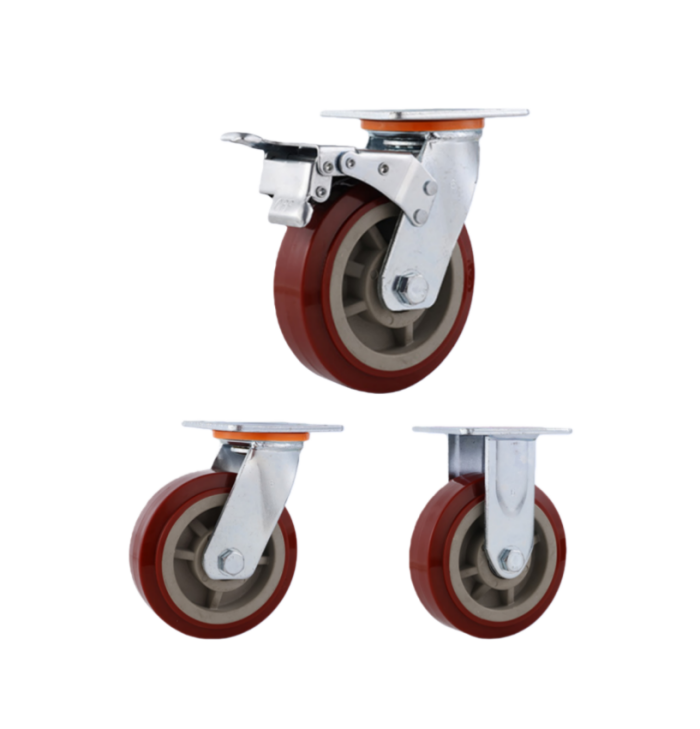
Case 1: Off-Center Loaded Mobile Cart
A mobile cart weighs approximately 520 kg and uses four casters.
The engineering team initially calculates:
520 ÷ 4 = 130 kg per caster
A caster with a 150 kg rating therefore appears sufficient.
However, most of the equipment mass is concentrated toward one side of the cart. During operation, the two casters on that side experience significantly higher loads.
After several weeks, the heavily loaded casters show:
· Wheel deformation
· Bearing noise
· Bracket bending
· Premature wear
The calculation was not necessarily wrong mathematically.
The problem was the assumption of equal load distribution.
A better approach is to estimate the load ratio on the heavily loaded side and size those casters accordingly.
Case 2: Six-Caster Machine Platform
An 1,800 kg machine is installed on six identical casters.
A simple calculation gives:
1,800 ÷ 6 = 300 kg per caster
However, the machine frame is rigid and the factory floor is not perfectly level.
When the machine moves, several casters do not share the load equally. The result is higher localized loading, particularly when crossing floor joints or thresholds.
In this situation, the engineering team should consider:
· Effective load-bearing points
· Frame rigidity
· Caster mounting tolerances
· Dynamic impact
· Wheel material
· Floor conditions
The goal is not simply to install more casters. It is to make sure the caster layout and frame allow the load to be carried reliably.
Before finalizing a caster specification, work through the following checks.
1. Confirm the actual gross weight
Include:
· Equipment weight
· Maximum payload
· Tools
· Batteries
· Accessories
· Consumables
· Any removable components that may remain installed during operation
Do not calculate caster capacity from the equipment's empty weight if the machine will normally operate fully loaded.
2. Identify the center of gravity
Ask:
· Is the load centered?
· Is most of the weight at one end?
· Is one side heavier?
· Is the center of gravity high?
· Does the payload position change during use?
For eccentric equipment, calculate the likely load on the most heavily loaded caster or caster group.
3. Check the caster layout
Review:
· Number of casters
· Caster spacing
· Wheelbase
· Swivel and rigid caster positions
· Mounting locations
· Frame dimensions
More casters do not automatically guarantee equal load distribution.
4. Separate static and dynamic requirements
If the equipment moves regularly, use the dynamic rating as a key selection parameter.
Consider:
· Travel speed
· Starting and stopping frequency
· Turning
· Towing
· Floor gaps
· Ramps
· Thresholds
· Impact frequency
5. Apply the appropriate safety margin
Select a safety factor according to the actual operating environment rather than using one number for every application.
6. Match the caster construction to the environment
Check:
· Wheel material
· Bearing type
· Bracket material
· Corrosion resistance
· Temperature resistance
· Chemical exposure
· Floor protection requirements
This final step is important because load capacity alone does not determine service life.
The 3-wheel load selection principle is a useful starting point for industrial caster sizing, but it is not the end of the calculation.
Once equipment becomes heavier, longer, mobile, or unevenly loaded, several additional factors become important:
· Eccentric load distribution
· Effective load-bearing points
· Dynamic loading
· Floor and operating conditions
· Safety-factor adjustment
· Wheel and bracket material
· Frame rigidity and mounting accuracy
The most heavily loaded caster—not the average caster—should drive the capacity decision for demanding applications.
For OEM equipment manufacturers, this application-based approach can reduce the risk of premature wheel wear, bearing failure, bracket deformation, and unexpected replacement costs.
CMCL Casters, a China-based industrial casters manufacturer, works with equipment manufacturers on caster configurations for heavy-duty mobile equipment, machinery platforms, carts, and other industrial applications. Its engineering approach considers load distribution, operating environment, wheel material, and mounting requirements rather than relying on nominal capacity alone.
When selecting a caster for a new machine or mobile platform, start with the actual load path and operating conditions. The right calculation is not simply about finding a caster that can carry the weight—it is about understanding which caster carries the weight, under what conditions, and for how long.